
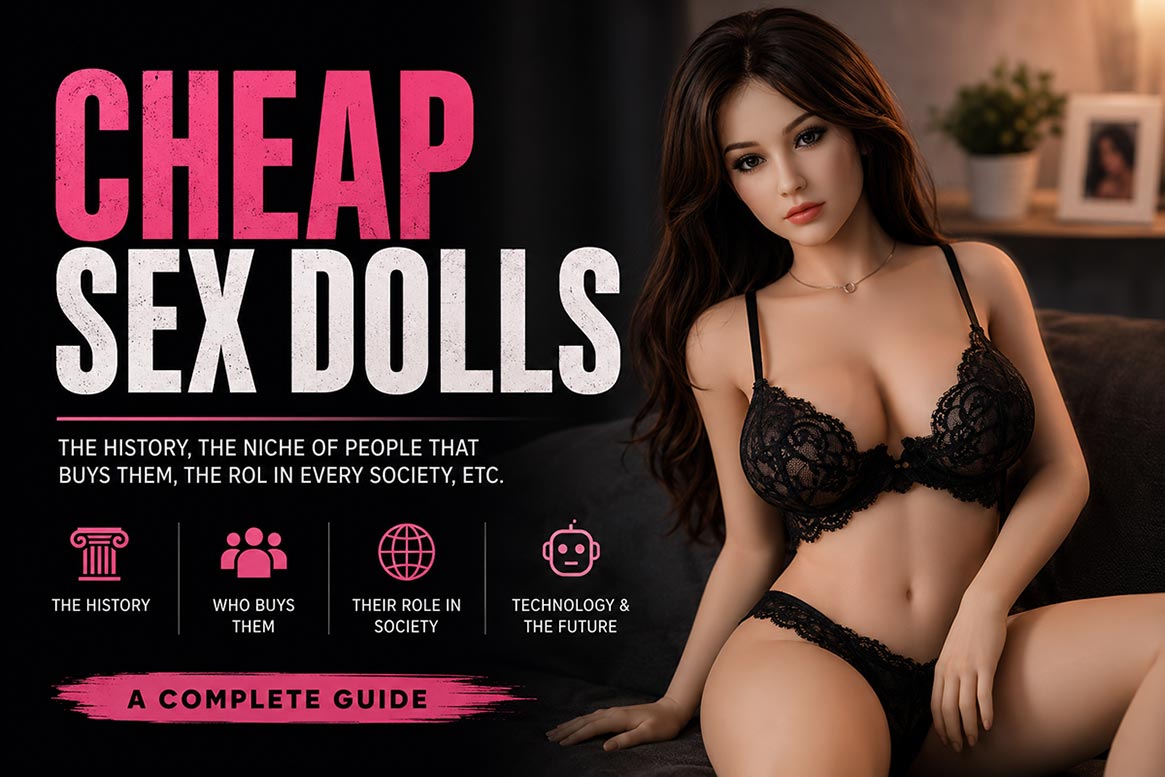
Sex dolls are often treated as a strange curiosity of the modern internet, but the idea behind them is considerably older than most people realize. Humans have created artificial representations of the body for centuries, sometimes for artistic, religious, psychological, or intimate purposes. What has changed dramatically is the technology, accessibility, and commercial market surrounding these objects.
Today, the market ranges from extremely expensive custom-made silicone models to relatively inexpensive inflatable or TPE dolls sold through online stores. The cheaper end of the market has opened the category to people who would never consider spending thousands of dollars on a high-end product.
But who actually buys these products? Why do they exist in almost every major consumer market? And what role do they play in contemporary society?
From Handmade Objects to Mass-Produced Products
The history of artificial companions is difficult to separate from the broader history of dolls, mannequins, sculptures, and other representations of the human body.
One frequently mentioned historical example is the so-called “Dutch wife,” a term associated with Southeast Asian regions and referring to a long body pillow or human-shaped object that could provide comfort while sleeping. Although its original meaning and historical usage were not necessarily equivalent to the modern sex doll, the concept illustrates something important: humans have long used artificial objects as substitutes for physical companionship.
During the 20th century, manufacturing technology began changing the category. Rubber, vinyl, plastics, and eventually advanced polymers made it possible to produce increasingly realistic human-shaped products at scale.
Early inflatable dolls were generally inexpensive and relatively simple. They were lightweight, easy to manufacture, and could be shipped discreetly. Their appearance, however, was usually far removed from the realistic products available today.
The internet transformed the industry again.
Instead of depending on specialized adult stores, consumers could privately research products, compare prices, read reviews, and order directly from manufacturers. This removed much of the embarrassment traditionally associated with purchasing such products and created a global market.
The Rise of the Affordable Sex Doll
The phrase “cheap sex doll” covers a surprisingly broad range of products.
At the lower end are basic inflatable models and simple TPE products. At higher prices are more sophisticated dolls featuring realistic skin textures, articulated skeletons, removable components, detailed faces, and increasingly sophisticated manufacturing techniques.
One reason prices have fallen is manufacturing competition.
As demand increased, particularly through online marketplaces, manufacturers in Asia and elsewhere began producing large numbers of dolls and related products. Economies of scale made it possible to offer products that once required expensive specialized manufacturing at substantially lower prices.
This created two distinct markets.
The premium market emphasizes realism, customization, materials, craftsmanship, and longevity.
The budget market emphasizes accessibility, experimentation, convenience, and price.
The existence of a cheap segment is important because it allows consumers to enter the category without making a major financial commitment.
For some buyers, a low-cost product is not necessarily intended to be a permanent purchase. It can simply be an experiment.
Who Buys Sex Dolls?
There is no single “typical” sex doll customer.
Popular culture often portrays the buyer as an isolated man who cannot establish relationships with other people. Reality is considerably more complicated.
Some customers are single. Others are divorced or widowed. Some are in relationships. Some purchase dolls because they are curious about the technology or novelty rather than because they lack human relationships.
There are also collectors and hobbyists who are interested in the craftsmanship and customization involved in realistic dolls.
Another important group consists of consumers who simply value privacy.
Traditional dating and relationships require time, social interaction, emotional negotiation, and often significant financial investment. A commercial product offers a completely different experience. For certain consumers, the appeal is precisely the absence of social pressure.
There are also customers with unconventional schedules or lifestyles. Someone who travels extensively, works unusual hours, or spends long periods away from home may perceive a doll as an object that provides a form of familiarity and companionship without requiring another person’s availability.
This doesn’t mean that every customer is lonely or socially isolated. Consumer motivations are much more diverse.
Loneliness and Artificial Companionship
Nevertheless, loneliness is an important part of the discussion.
Modern societies are experiencing significant changes in how people form relationships. Dating apps have dramatically increased the number of potential connections available to individuals, but they have also changed expectations around dating and relationships.
At the same time, people increasingly interact through screens rather than physically.
Sex dolls exist within this larger transformation.
A doll cannot replace every aspect of a human relationship, but it can provide a physical representation of companionship. For some people, that psychological distinction may matter.
The important question is therefore not simply whether a doll can “replace” another person. The more interesting question is why someone might want an artificial companion in the first place.
The answer can involve loneliness, curiosity, convenience, fantasy, privacy, physical comfort, or simply personal preference.
Sex Dolls Across Different Societies
Attitudes toward sex dolls vary enormously between societies.
In some countries, they are primarily viewed as novelty products. In others, they have become part of a much larger adult-products industry.
Japan is particularly interesting because it has a long history of commercializing highly specialized products related to intimacy, fantasy, dolls, and character culture. The Japanese market has also contributed significantly to the development of increasingly realistic artificial companions.
Western markets have approached the subject somewhat differently. Sex dolls have often been associated with adult entertainment and online pornography, although the category is gradually becoming broader.
Cultural attitudes also depend on religious traditions, social expectations, attitudes toward sexuality, and ideas about relationships.
In conservative societies, ownership may remain private and stigmatized. In more liberal consumer cultures, the same product may be treated as another category of personal merchandise.
This demonstrates an important principle: the object itself doesn’t determine its social meaning. Culture does.
The Economics of the Cheap-Doll Market
The economics of cheap sex dolls are particularly interesting because they demonstrate how internet commerce can transform a niche market.
A traditional adult store has significant limitations. It needs physical shelf space, inventory, employees, and a location. Large dolls are especially difficult because they are bulky products.
Online retailers have a different model.
A website can display hundreds of products without physically displaying all of them in a storefront. Manufacturers can ship products directly to consumers or distributors. Search engines and social media can bring potential customers to specialized websites without requiring traditional advertising channels.
Price competition is therefore intense.
Manufacturers compete on materials, realism, durability, appearance, shipping, customization, and increasingly on features.
The result is a market where consumers can find products at dramatically different price points.
Cheap products also create an important entry-level market. Someone who would never spend $3,000 on a premium doll might consider spending a few hundred dollars on a basic model.
That expands the overall consumer base.
Technology Is Changing the Category
The biggest change in the industry may not actually be the dolls themselves.
It may be the technology surrounding them.
Modern artificial companions increasingly incorporate articulated internal structures, improved materials, realistic skin textures, customizable faces, and more sophisticated manufacturing techniques.
3D modeling and digital manufacturing have made customization easier.
Artificial intelligence could eventually have an even greater impact.
A physical doll combined with an AI-powered conversational system is fundamentally different from a static product. Instead of simply being a physical object, the artificial companion could potentially have a recognizable personality, remember conversations, respond to questions, and adapt its behavior to an individual user.
That creates an entirely new category between traditional sex toys, dolls, robots, and AI companions.
Companies developing humanoid robotics are already demonstrating increasingly sophisticated machines capable of movement, speech, facial expression, and interaction.
The long-term question is therefore not simply whether sex dolls will become more realistic.
It is whether they will eventually become interactive.
The Psychological Debate
This technological development raises difficult questions.
Could artificial companions reduce loneliness for some people?
Could they encourage people to withdraw further from human relationships?
Could they become useful for people who have difficulty forming conventional relationships?
There is no simple answer.
Technology has historically changed human behavior in unpredictable ways. Telephones changed courtship. Television changed entertainment. The internet transformed dating. Smartphones changed communication.
Artificial companions could become another step in this process.
Some people may use them occasionally without any significant psychological impact. Others may develop strong emotional attachments.
That doesn’t necessarily make the technology inherently positive or negative. Much depends on how individuals use it.
Why Cheap Products Matter
The premium end of the market attracts attention because of its impressive realism, but the cheap market may actually be more important commercially.
Affordable products democratize access.
The same principle can be observed in almost every consumer technology. Expensive early versions eventually become cheaper as manufacturing improves and competition increases.
The first personal computers were expensive. Early smartphones were expensive. Digital cameras were expensive.
Eventually, mass production brought prices down.
The same economic process is occurring with artificial companions.
Materials that were once expensive become cheaper. Manufacturing becomes standardized. Supply chains improve. Online retailers increase competition.
The result is a product that becomes accessible to a much larger audience.
The Social Role of Sex Dolls
Perhaps the most interesting aspect of sex dolls is not their sexual function at all.
They reveal something about modern society.
They demonstrate that consumers are increasingly comfortable purchasing products designed around highly personal experiences. They also demonstrate the growing willingness to use technology in areas historically associated with human relationships.
A sex doll can represent many different things depending on the person using it.
For one customer, it may simply be an inexpensive novelty.
For another, it may be a private personal product.
For a collector, it may represent craftsmanship and customization.
For someone experiencing isolation, it may represent physical companionship.
For the technology enthusiast, it may be an early example of the future of artificial companionship.
There is no single interpretation.
What Comes Next?
The cheap sex doll market is unlikely to disappear. If anything, it is likely to become increasingly connected to broader developments in artificial intelligence, robotics, e-commerce, and personalized manufacturing.
The most significant evolution may be the transition from passive objects to interactive companions.
Imagine a future in which a consumer can select appearance, personality, voice, conversational style, and behavior from an online configuration system. Advances in 3D manufacturing could then make customized physical products increasingly affordable.
At that point, the industry would no longer simply be selling dolls.
It would be selling customizable artificial companions.
Whether that future becomes mainstream or remains a niche market is impossible to know. But the underlying forces are already visible: cheaper manufacturing, improved materials, online distribution, artificial intelligence, and changing attitudes toward relationships.
The history of sex dolls is therefore ultimately a history of technology meeting human intimacy.
From simple inflatable products to increasingly sophisticated silicone and TPE models, the category has evolved alongside society’s changing relationship with privacy, sexuality, commerce, and companionship.
And the cheapest products may have an unexpectedly important role in that evolution. By making artificial companionship affordable to ordinary consumers, they allow more people to experiment with a technology that could eventually become far more sophisticated than the products available today.

Related Posts