
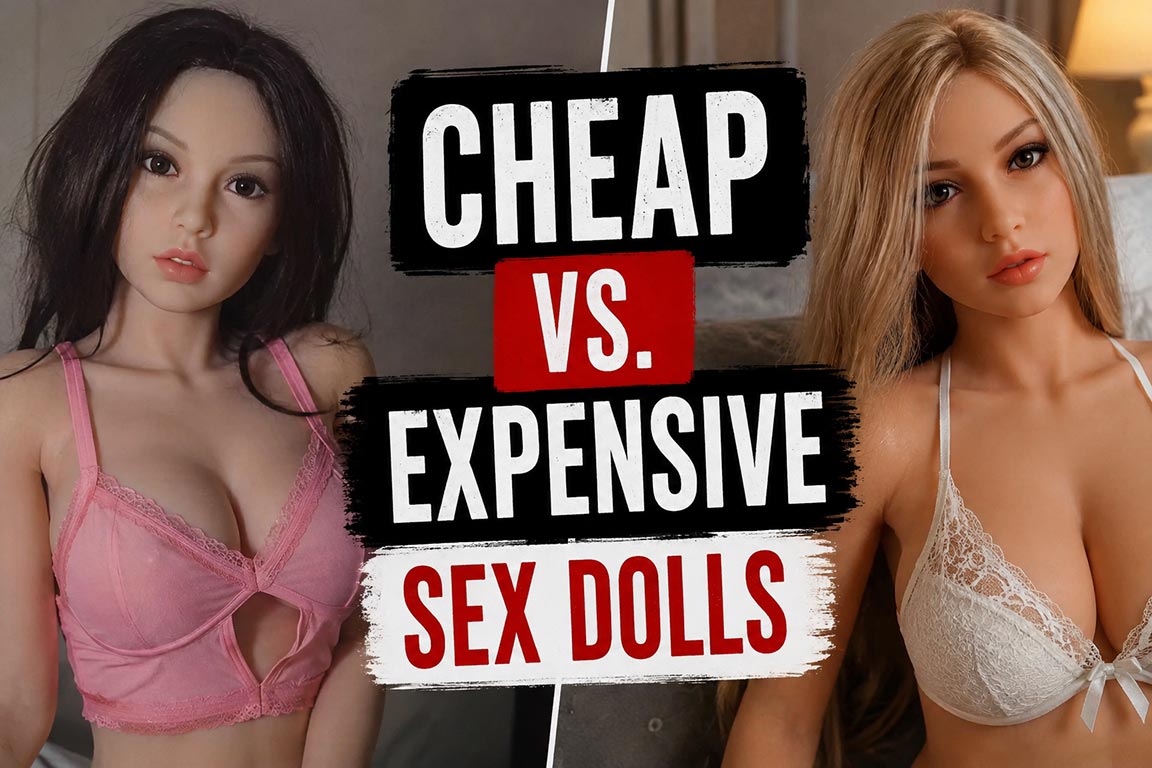
The price difference between sex dolls can be enormous.
At one end of the market, inexpensive models can cost a few hundred dollars. At the other end, premium dolls can cost several thousand dollars, with highly customized products sometimes going even higher.
At first glance, the difference may seem difficult to justify. After all, both products may look like human-shaped dolls. Why would one cost $300 while another costs $3,000 or more?
The answer is that the price difference is rarely about a single feature. It comes from a combination of materials, manufacturing processes, internal construction, realism, customization, quality control, durability, and the country in which the product is manufactured.
The cheap and expensive segments are really two different approaches to the same basic product.
Materials Make a Major Difference
One of the most important differences is the material used for the exterior.
Lower-priced products frequently use PVC, vinyl, or relatively inexpensive TPE-based materials. These materials allow manufacturers to produce large numbers of products at relatively low cost.
TPE, or thermoplastic elastomer, has become particularly common in the affordable and mid-range markets. It can provide a soft and flexible surface and can be manufactured in different textures and densities.
However, TPE has disadvantages. It is generally more porous than platinum-cured silicone and can require more maintenance. It may also be more susceptible to staining, degradation, or changes in texture over time.
Premium manufacturers often use higher-quality silicone, particularly platinum-cured silicone.
Silicone is more expensive to manufacture but offers several advantages. It can provide a more consistent surface, greater resistance to certain types of degradation, and a different feel and appearance.
This doesn’t mean that every expensive doll automatically uses better material, or that every cheap doll uses poor material. There is considerable variation within both categories.
The important point is that material quality is one of the first places where the price difference becomes visible.
Realism Is About More Than Appearance
A cheap doll can look surprisingly realistic in photographs.
This is partly because modern manufacturing techniques have improved dramatically. Computer-designed molds, detailed facial sculpting, high-resolution photography, and sophisticated finishing techniques can make relatively inexpensive products appear impressive online.
The difference becomes more obvious when looking at the physical construction.
Premium products generally invest more heavily in details such as facial sculpting, skin texture, hands, feet, hair, coloring, and overall proportions.
The finishing process can also be considerably more labor-intensive.
A low-cost manufacturer may use a standardized mold and produce thousands of nearly identical units. A premium manufacturer may spend significantly more time refining a particular design and applying additional finishing by hand.
This is one reason photographs can sometimes be misleading when comparing prices.
Two products may look relatively similar on a website while being substantially different when examined physically.
The Skeleton Inside Matters
Another major difference is what is underneath the exterior.
A sex doll is essentially a combination of an exterior body and an internal structure.
Inexpensive models may have relatively basic internal frames or simpler articulated structures. More expensive products generally invest more heavily in the skeleton.
Premium internal frames can provide better articulation, stronger joints, greater stability, and a more natural range of positioning.
This is especially important because the internal skeleton carries much of the mechanical load.
A doll can have an impressive exterior, but if the frame or joints are poorly engineered, the product may have a considerably shorter useful life.
Premium manufacturers therefore tend to spend more money on engineering, materials, testing, and quality control.
Weight Is Another Important Factor
A surprisingly significant difference between inexpensive and premium dolls is weight.
Realistic materials are heavy.
A full-sized product constructed from dense TPE or silicone with a metal skeleton can weigh many kilograms. Reducing weight generally requires compromises in materials, internal construction, or body density.
Some inexpensive products are deliberately designed to be lighter and easier to manufacture and ship.
This can be an advantage for buyers who need something easier to move or store.
Premium products, however, often prioritize realism and structural density rather than minimum shipping weight.
The result is a trade-off rather than a simple question of “better” or “worse.”
Customization Changes Everything
Customization is another area where expensive products separate themselves from the budget market.
Cheap products are typically sold as standardized configurations.
The customer chooses from a limited number of models, colors, sizes, or appearances and receives a mass-produced product.
Premium manufacturers may offer much greater customization.
Depending on the manufacturer, buyers may be able to choose different faces, body proportions, skin tones, hairstyles, eye colors, finishes, and other details.
Custom manufacturing is expensive because the manufacturer cannot simply produce thousands of identical units.
A customized product requires additional labor, different molds or components, individual finishing, and more complicated inventory management.
Consequently, customization can increase the price substantially.
Manufacturing Countries
Manufacturing location also influences pricing, although country alone should never be treated as a guarantee of quality.
A large proportion of the world’s sex-doll manufacturing industry is concentrated in China, particularly around established manufacturing clusters that specialize in silicone, TPE, molds, metal frames, plastics, and related products.
China’s enormous manufacturing infrastructure allows companies to produce large quantities at competitive prices.
This is one of the main reasons affordable dolls can be sold internationally at prices that would have been difficult to achieve decades ago.
Japan also has a significant cultural and commercial history surrounding realistic dolls and artificial companionship, although its market is more strongly associated with specialized premium products and domestic consumer culture.
Manufacturers and brands can also be found in Europe, North America, and other regions. In many cases, however, a company selling a product in Europe or the United States may not actually manufacture it there.
This distinction is important.
A product can be marketed by a European or American company while being manufactured in Asia.
Therefore, buyers should distinguish between the brand’s country, seller’s country, and actual manufacturing location.
Where Are the Buyers?
The consumer market is similarly international.
North America and Western Europe are important markets for realistic adult dolls, particularly because consumers in these regions generally have high purchasing power and widespread access to international e-commerce.
The United States is particularly important because of its large consumer market and extensive online adult-products industry.
European countries such as Germany, France, the United Kingdom, Spain, Italy, and the Netherlands also represent significant markets.
Australia and Canada are additional destinations for international sellers.
Asia is more complicated.
Countries such as Japan have longstanding cultural familiarity with dolls and artificial companionship, while China is simultaneously one of the world’s largest manufacturing centers and an important consumer market.
Different countries also have very different attitudes toward adult products, privacy, relationships, and artificial companionship.
Consequently, demand isn’t determined purely by income.
Cultural attitudes and regulations can be just as important.
Shipping Can Change the Real Price
A $500 doll and a $1,500 doll aren’t necessarily as different as their advertised prices suggest.
Shipping can make a major difference.
Large and heavy products are expensive to transport internationally. Depending on the destination, buyers may also have to consider import taxes, customs charges, handling fees, and local regulations.
This is particularly relevant when purchasing directly from overseas manufacturers.
A product advertised at an unusually low price may become considerably more expensive by the time it reaches the buyer.
Established local distributors sometimes charge more but provide domestic shipping, customer service, warranties, and easier returns.
That additional cost can be worthwhile.
Cheap Doesn’t Always Mean Bad
One of the biggest misconceptions about the market is that inexpensive automatically means low quality.
It doesn’t.
Cheap products can be perfectly reasonable for buyers who prioritize affordability.
A budget product may be suitable for someone who is experimenting with the category, wants a simpler design, or doesn’t need extensive customization.
In fact, some manufacturers deliberately produce simpler models because there is a large market for them.
The problem occurs when consumers expect a $300 product to perform like a $3,000 premium model.
That is where disappointment becomes likely.
Expensive Doesn’t Always Mean Better
The opposite assumption can also be misleading.
A high price doesn’t automatically guarantee exceptional quality.
Some of the cost of a premium product can come from branding, customization, marketing, distribution, or simply the reputation of the manufacturer.
Two products with similar materials and construction can sometimes have surprisingly different prices.
This is why experienced buyers tend to look beyond the headline price.
Material specifications, internal frame design, warranty conditions, replacement parts, manufacturer reputation, customer reviews, shipping costs, and maintenance requirements can be more useful indicators.
The Mid-Range Market May Be the Sweet Spot
Between the extremely cheap and extremely expensive products is a growing middle market.
These products often use TPE or improved silicone, stronger internal structures, better finishing, and more customization than entry-level models while remaining considerably cheaper than fully customized premium products.
For many consumers, this represents the most attractive compromise.
The buyer gets improved realism and construction without paying for every possible premium feature.
This is also where competition between manufacturers is particularly intense.
As manufacturing technology improves, features that were once exclusive to expensive products gradually migrate downward into cheaper models.
Technology Is Bringing Prices Down
This trend is likely to continue.
Computer-aided design, automated manufacturing, improved molds, better polymers, and increasingly sophisticated supply chains are reducing production costs.
A feature that costs hundreds of dollars to implement today may become inexpensive in the future.
Artificial intelligence could eventually create another major shift.
Future products may combine physical bodies with conversational AI, sensors, voice recognition, and personalized software.
At that point, the price difference may no longer be determined primarily by the physical body.
Software, electronics, robotics, and subscription services could become equally important.
So, What Are You Actually Paying For?
Ultimately, the difference between a cheap and expensive sex doll comes down to several factors.
Cheap models primarily sell accessibility.
They are mass-produced, standardized, relatively simple, and designed to keep manufacturing and shipping costs under control.
Expensive models sell refinement.
They typically offer better materials, more sophisticated internal structures, improved finishing, greater customization, more detailed manufacturing, and stronger quality control.
But the most expensive product isn’t necessarily the right product for every buyer.
Someone looking for an inexpensive introduction to the category has very different requirements from someone looking for a highly customized long-term product.
The best way to compare products is therefore not to ask, “Which one is better?”
The better question is:
Which features are actually worth paying for?
For some buyers, the answer may be a simple, affordable model.
For others, the additional cost of premium materials, customization, durability, and realism may be justified.
And as manufacturing technology continues to improve, the most interesting development may be that the gap between cheap and expensive products gradually becomes smaller.
What costs thousands of dollars today may eventually become an ordinary consumer product — and that could fundamentally change the economics and culture of the entire industry.
